Exercise statement
Prove Lemma 4.1.11.
Lemma 4.1.11 (Properties of order). Let  be integers.
(a)  if and only if
  is a positive natural number.
(b) (Addition preserves order) If , then  .
.
(c) (Positive multiplication preserves order) If and  is positive, then
  .
.
(d) (Negation reverses order) If , then  .
.
(e) (Order if transitive) If and  , then
  .
.
(f) (Order trichotomy) Exactly one of the statements ,  , or
, or  is true.
Hints
- Use the first part of this lemma to prove all the others.
- You might find Exercise 4.1.3 helpful.
How to think about this exercise
This is a straightforward exercise as long as you follow the hints.
Model solution
(a) Suppose . This means that  and
and  . Since , we have
  for some natural number
  . Add
. Add  to both sides of this equation to obtain
  , where the last two equalities follow from the laws of algebra (Proposition 4.1.6). Thus is equal to a natural number. If
  , then
  so , a contradiction. Thus
  , which means is a positive natural number.
Now suppose is a positive natural number. Thus  , where is a natural number. By adding
  to both sides we obtain
  , i.e. . Thus . If then we would have
  , which contradicts the fact that . Thus , which together with implies that .
(b) Suppose . By part (a), this means is a positive natural number. By the laws of algebra,  . By Exercise 4.1.3,
  and
and  . Thus
  , where we have used the distributive law. We thus have
  . Since this is a positive natural number, by part (a) again we see that .
(c) Suppose and is positive. By part (a), we see that is positive. Thus by Lemma 2.3.3 we see that  is positive. We have
  , where we have used the distributive law and Exercise 4.1.3. Since
  is positive, by part (a) again we see that .
(d) Suppose . Thus by part (a) we see that is positive. To show that  , we need to show that
  is positive. But
  . We have
  . Thus
  . Since is positive, and
  , we see that
  is positive as required.
(e) Suppose and . Thus by part (a), we see that and  are positive. By Proposition 2.2.8, we thus see that
  is a positive number. By part (a) again, we thus see that as desired.
(f) We first show that at least one of , , or is true. Consider the integer . By trichotomy (Lemma 4.1.5) it is zero, positive, or negative. If then . If is positive then by part (a), we have that . If is negative, then  for some positive natural number , so
  is positive. But
  , so by part (a) we have
  .
.
Now we show that at most one of , , or is true. If and then and  are both positive. But if
  is positive then for positive natural number , so , i.e. is negative. Thus is both positive and negative, which contradicts the trichotomy of integers. If and then we have both and , a contradiction. Similarly we cannot have both and .


 with another rational number
  which is equal to
  .
. . In other words, the component-wise sum of two rational numbers is the sum of the numerators “divided by” the sum of the denominators. (Remember, this definition is ill-defined, so no such operation actually exists!)
 but
but  and
and  . Are these two rationals equal? Well,
  . Even a single example where the outputs are different proves that the operation is not well-defined.
 , so that
  . Now
. Now  and
and  . To show that these are equal, we must show
  . Expanding this, we have
  and
and  . The first term in each is the same, since
  . So it suffices to show that
  . How can we do this? We can’t! There is nothing in our assumption

 are non-zero and
  . The left side is
  and the right side is
  . So we want to show that
  . But
. But  , which is what we want (after reordering the factors). Similarly if
  then
then  . Now
. Now  and
and  so we want to show that
  , which we have since
  .
. and
and  by definition of negation. We thus have to show that
  , i.e.
  . But this follows from multiplying both sides of the equation
  and using
  be rational numbers. Thus there exist integers
  , with
  non-zero, such that
  ,
,  , and
, and  .
. , i.e.
  . But by definition of equality,
  , which is the case since equality is reflexive for integers.
 implies
  . So suppose
  , i.e.
  . To show
  , i.e.
  . Since equality for integers is symmetric, we see that
  , so we are done.
 . We must show that
  . Since
  , i.e.
  . By multiplying the first equality by
  we have
  , and by multiplying the second equality by
  we have
  . Since equality on the integers is transitive, we have
  . But
. But  is non-zero, so by
  . Now we have two cases. If
  , we can use Corollary 4.1.9 again to obtain
  , i.e.
  . On the other hand, if
  then
then  so
so  , and since
  ,
,  . Similarly,
  so
so  , so
, so  since
since  , which means


 , you get for free that
  , and once you also prove
  ,
,  , and
, and  .
. and
and  , where the last equality follows from the commutativity of addition on the natural numbers. Thus one sees that
  .
.

 . So we just need to show
  . We have
  .
. . So we just need to show that
  . We have
 since
since  .
. and
and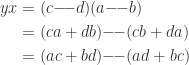
 by the commutativity of multiplication, which was shown above. Thus we can just show
  . We have
  .
.

 by the commutativity of multiplication, the distributive law, and commutativity again, all of which were shown earlier in the proof.
 and
and  . If
. If  are sets, then the union operation is commutative (i.e.,
  ) and associative (i.e.,
  ). Also, we have
  .
. is an element of
  , and vice versa. Suppose that
  is an element of
  or
or  . If
. If  . Thus by Axiom 3.4 we see that
  . On the other hand if
  and so
  or
or  . And if
  . Thus by Axiom 3.4,
  or
or  . If
. If  . And if
  is in
is in  , so
, so  if and only if
  if and only if
  ; but
; but  if and only if
  ,
,  ,
,  , and
, and  are all distinct (i.e., no two of them are equal to each other).
 . However,
  by Axiom 3.2. Thus not every element of
  . Similarly,
  but
but  , so
, so  . Also,
  but
but  .
. if and only if
  . Considering the case
  , it follows that if we can show that
  . But we already showed in the previous paragraph that
  .
. if and only if
  . Since we showed in the first paragraph that
  . Also by Axiom 3.3, we see that
  if and only if
  . But by the first paragraph of this proof,
  . Thus
  , which means that we have found an element, namely
  . But every element
  belongs to
  . Then if
  then
then  , so
, so  . Symbolically, we are given
  and we want to show
  . The result follows because
  and
and  are logically equivalent.
 and
and  . We want to show that
  . Let
. Let  we see that
  . Similarly, if
  , then
  have exactly the same elements, so
  .
. be a positive number. Then there exist natural numbers
  such that
  and
and  .
. and increment
  stays the same) or the remainder resets to 0 (in which case
  . For example, suppose we are at “14 divided by 5 = 2 with remainder 4”. Then the remainder, 4, is one less than the number we are dividing by, which is 5.
 , we must show that there are natural numbers
  . We can take
  and
and  . Indeed, we have
  (since
  .
. such that
  and
and  .
. . If
. If  , we can take
  and
and  . Then
  and we have
  equal to
  by definition of
  , which equals
  by the distributive law, which equals
  by using
  , which equals
  by the inductive hypothesis
  . Thus
  as required.
 . In this case,
  from the inductive hypothesis gives
  , so
, so  . So we can take
  and
and  . Now
. Now  by definition of
  , we have
  .
. fixed and induct on
  . The left hand side is
  and the right hand side is
  so the two sides are equal.
 . We want to show that
  . Starting from the left hand side,
  equals
  by the definition of multiplication, which equals
  by the distributive law, which equals
  by the inductive hypothesis, which equals
  by the definition of multiplication. Thus, the two sides are equal, which closes the induction.
 Tao Analysis Solutions