Exercise statement
Suppose you know that whenever  is true, then
  is true; that whenever is true, then
  is true; and whenever is true, then is true. Is this enough to show that
  are all logically equivalent? Explain.
Hints
None.
How to think about the exercise
Once you’ve done this exercise and the previous one, you might be wondering if there’s a general rule for figuring out when a given list of statements consists of logically equivalent statements. Here’s one attempt. Draw all the statements as nodes on a graph, then write a directed edge whenever there is an implication. For this exercise you end up with the following graph:

Now what you have to ask is, starting at any node, can I get to any other node? In this case it’s pretty clear that yes, you can do that. So this means the three statements are equivalent.
Suppose we are given a more complicated implication structure like the following:

How can we tell if all of these statements are logically equivalent? Well, one way is to just check one by one. Starting at  , can I get to every other node?
  . So yes. Now starting at
  , … and so on. At the end you will get a yes or no answer (the answer is “no”).
But there is a better way to go about this, which is to detect subsets of the nodes which are logically equivalent, and then join them together into a single node. For instance, we can see immediately that and are logically equivalent, so we can join those two nodes together:

And now, we see that  ,
,  , and
, and  form a cycle, so they are logically equivalent (starting from anywhere in a cycle, you can go around to reach each of the other spots). So we can join them together:

We can say we are done here, but notice that there are two ways to get from  to
to  : we can go directly or we can go via
  . We don’t really need the former arrow, since we can still get to even if we erase it. (On the other hand, we can’t get rid of the arrow pointing to , since then there would be no way to get to , so the implication structure will have changed.) So we can erase it to make the graph slightly cleaner:

Now it is pretty clear what is going on. The statements  are all logically equivalent, and they are the strongest statements, because they imply everything else. Then comes , which implies but not the other statements. Finally there is , which does not imply any other the other statements.
Unlike the first method, which just gave a yes or no answer, this second method tells you more, because it gives you a subset of the statements which is logically equivalent, and also tells you the strengths of the statements more generally.
Model solution
Yes, this is enough to show that are all logically equivalent. If is true, then is true. And since is true, we see that is true. Thus whenever is true, the other two statements are also true. Similarly, we can show that whenever is true, and are also true, and that whenever is true, and are also true. This means that whenever one of the statements is true, the other two are both true.
If is false, then is false (if were true, then would have to be true, which would contradict the fact that is false). And since is false, we see that is false. Thus whenever is false, the other two statements are also false. A similar reasoning shows that whenever one of the statements is false, the other two are also false.
 . And since
  . Thus if
  . And since
  . Thus if
  and
and  . But
. But  (since the latter is just the
  be a real number, let
  , and let
  . So if
  we see that
  . But the contrapositive of
  . Since the contrapositive of an implication is logically equivalent to it, this means that we have both
  , i.e.
  with another rational number
  which is equal to
  .
. . In other words, the component-wise sum of two rational numbers is the sum of the numerators “divided by” the sum of the denominators. (Remember, this definition is ill-defined, so no such operation actually exists!)
 but
but  and
and  . Are these two rationals equal? Well,
  . Even a single example where the outputs are different proves that the operation is not well-defined.
 , so that
  . Now
. Now  and
and  . To show that these are equal, we must show
  . Expanding this, we have
  and
and  . The first term in each is the same, since
  . So it suffices to show that
  . How can we do this? We can’t! There is nothing in our assumption

 are non-zero and
  . The left side is
  and the right side is
  . So we want to show that
  . But
. But  , which is what we want (after reordering the factors). Similarly if
  then
then  . Now
. Now  and
and  so we want to show that
  , which we have since
  .
. and
and  by definition of negation. We thus have to show that
  , i.e.
  . But this follows from multiplying both sides of the equation
  and using
  be rational numbers. Thus there exist integers
  , with
  non-zero, such that
  ,
,  , and
, and  .
. , i.e.
  . But by definition of equality,
  , which is the case since equality is reflexive for integers.
 implies
  . So suppose
  , i.e.
  . To show
  , i.e.
  . Since equality for integers is symmetric, we see that
  , so we are done.
 . We must show that
  . Since
  , i.e.
  . By multiplying the first equality by
  we have
  , and by multiplying the second equality by
  we have
  . Since equality on the integers is transitive, we have
  . But
. But  is non-zero, so by
  . Now we have two cases. If
  , we can use Corollary 4.1.9 again to obtain
  , i.e.
  . On the other hand, if
  then
then  so
so  , and since
  ,
,  . Similarly,
  so
so  , so
, so  since
since  , which means
  be integers.
 if and only if
  is a positive natural number.
 .
. is positive, then
  .
. .
. , then
  .
. , or
, or  is true.
 and
and  . Since
  for some natural number
  . Add
. Add  to both sides of this equation to obtain
  , where the last two equalities follow from the laws of algebra (Proposition 4.1.6). Thus
  , then
  so
so  , which means
  , where
  to both sides we obtain
  , i.e.
  , which contradicts the fact that
  . By
. By  and
and  . Thus
  , where we have used the distributive law. We thus have
  . Since this is a positive natural number, by part (a) again we see that
  is positive. We have
  , where we have used the distributive law and Exercise 4.1.3. Since
  is positive, by part (a) again we see that
  , we need to show that
  is positive. But
  . We have
  . Thus
  . Since
  , we see that
  is positive as required.
 are positive. By Proposition 2.2.8, we thus see that
  is a positive number. By part (a) again, we thus see that
  for some positive natural number
  is positive. But
  , so by part (a) we have
  .
. are both positive. But if
  is positive then


 , you get for free that
  , and once you also prove
  ,
,  , and
, and  .
. and
and  , where the last equality follows from the commutativity of addition on the natural numbers. Thus one sees that
  .
.

 . So we just need to show
  . We have
  .
. . So we just need to show that
  . We have
 since
since  .
. and
and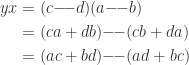
 by the commutativity of multiplication, which was shown above. Thus we can just show
  . We have
  .
.

 by the commutativity of multiplication, the distributive law, and commutativity again, all of which were shown earlier in the proof.
 Tao Analysis Solutions