Exercise statement
Prove Proposition 7.2.5.
Proposition 7.2.5. Let  be a formal series of real numbers. Then converges if and only if, for every real number
  , there exists an integer
  such that
 for all
  .
.
Hints
- Use Proposition 6.1.12 and Theorem 6.4.18.
- If you want to do this exercise correctly, it is not as easy as just applying the given Proposition and/or Theorem!
How to think about the exercise
If you look up the hints, it is quite obvious how the exercise is done. I wanted to give a thought process of how to approach the problem if one randomly saw it (i.e. without accompanying hints), so in what follows I won’t be assuming that the hints have been given.
Let’s write out the two sides of the “if and only if” by making the quantifiers explicit:
For all there exists such that for all we have  (1)
(1)
The claim that converges is:
For all there exists such that for all  we have
  (2)
(2)
Above, I have used  to denote the sum. It’s actually equal to
  .
.
This shows something interesting. When formalizing what it meant for a series to converge, i.e., when writing out (2), we had to refer to what the sum converges to, i.e., to . But in (1), we did not even have to refer to the final sum! In other words, (1) encodes the claim “this series converges” without talking about what the series converges to. This sounds awfully familiar … didn’t we have a way to say “this sequence converges” without referring to the limit of the sequence? That’s right, this is sounding exactly like what Cauchy sequences are. And in fact, if our pattern-matching is active, we might even notice that in (1) we had “for all ” which is reminiscent of the “for all  ” that we used a lot when dealing with Cauchy sequences (the variable names don’t matter of course).
So let’s see … if  is the
  th partial sum of the series, then
  is basically equal to
  . (How did I see this? It was so quick it’s hard for me to say what my mind did here. I suppose it’s pattern-matching on things I’ve seen before, e.g. the integral rule
  , which can be written in subtracted form as
  .) So is basically saying
  . So (1) is basically saying that
  is Cauchy. And we have exactly the theorems to show that “is Cauchy” and “is convergent” are the same for sequences.
I said “basically” above because  only holds when
  . When
  , the sum
  whereas is not necessarily zero; instead it’s equal to
  . And actually, I’ve made an off-by-one error: should actually be
  . So this exercise is perhaps not as simple we thought! The first challenge was to figure out the “big idea” or strategy to use (i.e., recognize that Cauchyness is relevant), and the second challenge is now to make our idea actually work by getting all of the details right. Let’s write out all the variations of the claims we are working with, to get things straight:
is Cauchy (a)
For all there exists such that for all we have (b)
For all there exists such that for all we have  (c)
(c)
For all there exists such that for all we have (d)
Our goal is to show that (a) and (d) are the same (why do we want to show both directions? It’s because the original Proposition is stated as an “if and only if”). That will allow us to use the fact that a sequence is Cauchy iff it is convergent.
It’s clear that (a) and (b) are equivalent, since (b) is just what it means for a sequence to be Cauchy. So we just need to show that (b) and (c) are equivalent and that (c) and (d) are equivalent.
(c) implies (b) since if holds for all , then since  as well, we have
  , i.e., .
(b) implies (c) since if we have some such that for all , then we can pick  and see that if
  then
then  and so .
(The above two paragraphs are similar to Exercise 6.1.3 and Exercise 6.1.4. In all cases, what matters is what happens at the limits so shifting things around a bit won’t change whether a statement is true.)
So now we just have to show that (c) and (d) are equivalent. Being very mindful of off-by-one errors now, if we have  , and if instead we have and
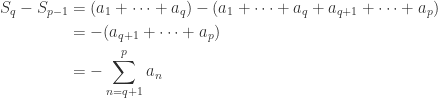
So whatever  are, we have
  . This means (c) implies (d): if the bigger thing is less than
  , then so is the smaller thing. To show that (d) implies (c) as well, let . Since (d) is true, we have some ; pick this . Now let . If , we have so we have
  . If then from (d) we have
  . But we know that
  , so actually we want to show that
  . But this is possible since
  . So in other words we have

That was a lot of fiddly details, but we’re finally done.
Model solution
Let be the th partial sum of the series . By definition of series convergence, converges iff the sequence converges.
We will show that is Cauchy if and only if, for every there exists an integer such that for all we have  . If we can do this, then Theorem 6.4.18 will guarantee the result that we are trying to show.
First suppose that is Cauchy. Let . Since is Cauchy, this means that there exists an integer such that for all we have . Consider the number . If , then  . Now we have two cases. If , then the sum is equal to (Lemma 7.1.4(a)), so we have
  by Cauchyness. If on the other hand , then
  (Definition 7.1.1). Let us summarize: we let , then found a number
  such that if then . So we’ve completed the first direction of the proof.
Now suppose that for every there exists an integer such that for all we have . Let . From our assumption, we are given some , so pick this . Now let . We have , and we want to show . We have three cases:
- If
 then
then  .
.
- Next, if
 then
then  and we have
  by Lemma 7.1.4(a). And since
  we can say that
  . But this means as required.
- Finally, if then
 and we have
  . But since
  we have , so
  as required.
In all three cases we have shown that so we are done.
 be a sequence of real numbers, and let
  be a real number. Then the following two statements are logically equivalent (each one implies the other):
 . Now we want to show that every subsequence of
  be a subsequence of
  such that
  for all
  .
. implies
  . How do we find such an
  . Okay, that is pretty close to what we want. Since we don’t know any other
  . (*)
. (*) ;
; .
. (because of (*)). In other words, we want to know if
  , so that
  . (Here I have “cheated” a bit. I have seen the pattern “
 , and if
  , we have
  , so
, so  . So that completes the proof that (a) implies (b).
 such that:
 we have
  . By definition of
  is
is  . Now suppose inductively that
  Tao Analysis Solutions