This post was written by Berke Özgür Arslan, who has generously offered to help Issa complete the blog. It has been edited and converted into the WordPress blog post format by Issa.
Exercise statement
Prove part (c) of Proposition 6.4.12. (Since this is a long exercise, Issa has decided to split it up across different blog posts.)
Proposition 6.4.12. Let  be a sequence of real numbers, let
  be the limit superior of this sequence, and let
  be the limit inferior of this sequence (thus both and are extended real numbers).
(a) For every  , there exists an
  such that
  for all
  . (In other words, for every , the elements of the sequence are eventually less than
  .) Similarly, for every
  there exists an such that
  for all .
(b) For every  , and every , there exists an such that
  . (In other words, for every , the elements of the sequence exceed infinitely often.) Similarly, for every
  and every , there exists an such that
  .
.
(c) We have  .
.
(d) If  is any limit point of , then we have
  .
.
(e) If is finite, then it is a limit point of . Similarly, if is finite, then it is a limit point of .
(f) Let be a real number. If converges to , then we must have  . Conversely, if , then converges to .
Hints
This is a tricky exercise and there are a few ways to approach it. One way is to split by cases based on whether and are finite,  , or
, or  (it should also be possible to split by cases depending on whether the original sequence
  is bounded or not). For this approach, you may want to decide whether the sequences
  and
and  are increasing or decreasing, then to compare their terms, and then to use Proposition 6.3.8 followed by a version of Corollary 5.4.10 for sequences of real numbers. For the cases in which and may not be finite, use part (a) of the proposition.
How to think about the exercise
The concepts of limit superior and limit inferior may be difficult to grasp when one encounters their definitions for the first time. A very helpful picture to keep in mind is the piston analogy that Tao gives before the statement of Proposition 6.4.12. As we keep removing elements  , then
  , and so on, the supremum piston can only slip leftward. This suggests that the sequence
  is a decreasing sequence. One of the few results we have so far about decreasing sequences is Proposition 6.3.8 , so it is a good bet that we will want to make use of that result.
So the first thing to try in order to tackle this proof is to treat the sequences  and
and  like we would treat any regular sequence. We are dealing here with the infimum and the supremum of these sequences respectively; so it would be nice to use Proposition 6.3.8 and convert the infimum and supremum of these sequences into their limits. But this is only possible when is decreasing and bounded below, and is increasing and bounded above. For the boundedness, luckily, the cases in which these sequences are not bounded correspond to the cases in which and are either or , so we can treat these cases separately, and it is seen easily that these cases do not violate the proposition.
In order to see whether is increasing or not, we need to refer to its definition. For some number  , we know that
  is the infimum of the terms
  starting with the index . Therefore, informally, we can say that the infimum of a sequence starting from a smaller index, say, 5, cannot be greater than of a sequence starting from a greater index, say, 10. This is because the sequence starting from index 5 contains the sequence starting from index 10, and it is “easier” to find an even smaller infimum when we have more elements to choose from. (If that was difficult to follow, you can also consider a piston moving to the right and slipping rightward.) Then we must conclude that the sequence of infima is an increasing sequence. You should figure out an analogous argument for the sequence of suprema. Then we just use Proposition 6.3.8 to conclude that limsup and liminf are just the limits of these sequences. (This also justifies the notation
  and
and  : is the limit of the suprema, i.e.
  , and similarly for .)
After this, we need to make another important observation. If we pick yet again any number , then is the infimum of the sequence  , and
, and  is its supremum. Clearly, we have
  , and by the analogue of Corollary 5.4.10 for real sequences this means that their limits will behave accordingly; and we get the desired result.
While considering the cases where and may not be finite, the following table might help you to keep track of what you need to show. Check marks indicate that their corresponding cases already satisfy the proposition because is always larger than any extended real number, and is smaller than any extended real number, so there is nothing to show. In the proof, we show that the cases indicated with a question mark cannot exist. Try to see why the assertions (1) “If  , then
  ”, and (2) “If
  , then
  as well” exclude these cases.
Model solution 1
Consider first the inequality  . Now, is defined to be the infimum of the sequence where
  , so it should be smaller than any particular element of this sequence. Therefore
  for all , and in particular for
  , we have
  . A similar argument gives the inequality
  . Thus we only need to show that
  to finish part (c).
We first assume that both and are real numbers, i.e. neither of them are  or
or  . In this case, we first want to show that the sequences and are sequences of real numbers, i.e. that none of the elements are or . Consider first the sequence . We show each of the possibilities that an element is or leads to a contradiction:
- If some element
 , then since is the infimum of this sequence we must have
  , a contradiction of Definition 6.2.3 (a real number cannot be less than or equal to ).
- Suppose some element
 . We first show that the original sequence is not bounded above. If there were some upper bound
  for the whole sequence, then this
  would also be an upper bound for the sequence
  starting at
  . Since
  is the least upper bound of this sequence and is merely an upper bound, we have
  , a contradiction of the fact that is a real number. Thus the original sequence is not bounded above. But this means that
  , so the infimum of this sequence is
  , a contradiction.
A similar argument shows that is a sequence of real numbers.
Now let us be reminded that if  and
and  are sets of real numbers such that
  , then
  , and
, and  . Now, for some , by definition, we have
  (and a similar definition for the supremum). Thus if
  , then
  , and we must have
  . Thus the sequence is an increasing sequence. By a similar argument, we see that is a decreasing sequence.
Since  is a real number, the increasing sequence is bounded above, and since every increasing sequence which is bounded above is convergent by Proposition 6.3.8, we have
  . With a similar argument for decreasing sequences which are bounded below we also have
  . (Note: it is the application of Proposition 6.3.8 that required the sequences and to consist solely of real numbers.)
Now let be any number. The infimum of  is smaller than
  , and the supremum of the same sequence is larger than , so we have:

In other words, we have the term-wise comparison  . Since this is true for every , we have by the analogue of Corollary 5.4.10 for real sequences that
  . To summarize, we have:

as desired.
Now, we consider the cases in which and are possibly or . If or if , there is nothing to show. Thus we only need to show two things: (1) if , then , and (2) if , then as well. For (1), suppose for the sake of contradiction that , and  . Since , then by part (a) of the proposition, for every number
  , we have that
  , so there exists an
  such that for all
  . This means that the sequence
  doesn’t have an upper bound. Then for each , we must have
  . But then we have
  , a contradiction. Similarly, for (2), if , then again by (a), for every number
  , since
  , there exists an such that for all , meaning that the sequence the sequence doesn’t have an lower bound, i.e. for each , we have
  . And then
  , as desired.
Model solution 2
(This section was written by Issa.)
There is another, shorter proof of part (c) that does not require breaking up the proof into cases. This proof is very neat, and I encourage you to check it out, but I also believe it is more difficult for beginners to discover. I may write it up here in detail later, but for now please check out this writeup by Sangchul Lee; it is Exercise 8(iii) on page 5.

 be convergent sequences of real numbers such that
  for all
  . Then
  .
. and
and  . We are trying to show that
  . Suppose for the sake of contradiction that
  . Then
  so for
  we can find some
  such that
  for all
  , and some
  such that
  for all
  . Thus if we pick
  then since
  and
and  we have both
  and
and  . These two inequalities say in particular that
  and
and  . Thus we have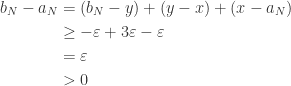
 , which contradicts the fact that
  . By the limit laws,
  , so it suffices to show that
  .
. , and show that its limit is non-negative. To simplify the exposition, let us define
  . Then since
  for each
  , our goal is the following: we want to show that if
  is a sequence such that
  for all
  , then
  .
. . Then by the definition of sequence convergence, for any
  , there exists
  for each
  , then we could find some
  such that
  . But since
  Tao Analysis Solutions